
Meta Description:
Thinking about closing an old credit card? Learn how it really affects your credit score, the difference between FICO and VantageScore, and when keeping it open is smarter.
Written by Credit Builder Guide Editorial Team
Credit Builder Guide is dedicated to helping Americans understand credit scores, improve financial habits, rebuild damaged credit, and make smarter borrowing decisions through simple, research-based educational content.
Fact-checked using trusted U.S. financial resources • Updated for 2026
The Dilemma: Four Cards, One Decision
Imagine you open your wallet and count four credit cards. One is a basic card you opened back in college twelve years ago with no annual fee and a $2,000 limit. You have not swiped it in three years. Another is a travel rewards card with a $450 annual fee that you barely use now that your job no longer requires flying. A third carries a $6,000 balance at 24% APR, and the fourth is a store card for a retailer you stopped visiting after moving to a new city.
You want to simplify your finances. You have heard that too many cards look bad to lenders. You also worry about identity theft on dormant accounts. So you think: Why not just close the old ones?
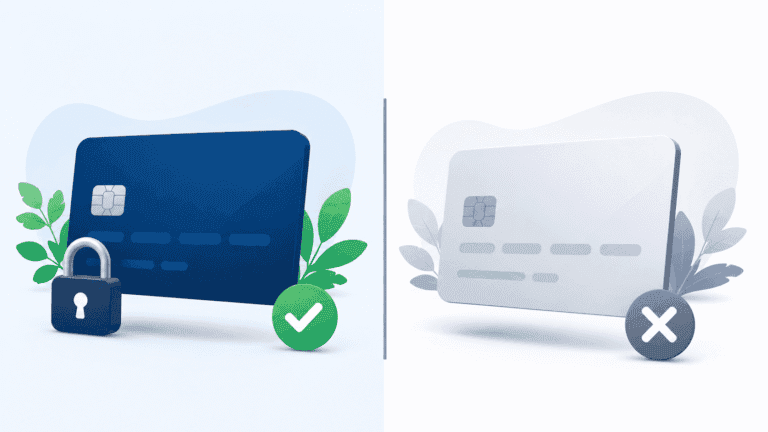
Before you call the issuer, you need to understand something critical. Closing a credit card can hurt your credit score, but the damage does not always happen the way people expect. The impact depends on which scoring model a lender uses, how much available credit you lose, and whether the card is propping up the age of your credit history. In some cases, closing the wrong card can cost you 20 to 50 points. In others, the impact is barely noticeable.
This article explains exactly what changes when you close an old credit card, why the effects differ between FICO and VantageScore, and how to make the decision without sabotaging the credit profile you have spent years building.
What Actually Happens When You Close a Credit Card
Closing a credit card is not inherently bad. The account does not disappear from your credit report the moment you hang up with customer service, and your score does not automatically crater. However, three specific factors in your credit profile can shift, and two of them matter immediately.
Those factors are:
- Credit utilization ratio — the percentage of available credit you are using.
- Length of credit history — the age of your accounts, including your oldest and your average.
- Credit mix — the variety of credit types on your report.
The first factor, utilization, usually changes within one billing cycle. The second, credit history age, may not change at all for years—or it may change immediately, depending on whether your lender pulls a FICO or VantageScore. The third, credit mix, only matters if the card you close is your only revolving account.
Understanding how each factor interacts with your specific credit profile is the key to making a smart decision.
The Utilization Trap: Why Your Score May Drop Immediately
Credit utilization is the single biggest reason closing a card hurts your score. It accounts for roughly 30% of your FICO score and is highly influential in VantageScore models as well. When you close a credit card, you lose its credit limit from your total available credit. If you carry balances on other cards, your utilization ratio jumps instantly—even though your actual debt did not change by a single dollar.
Consider a hypothetical borrower named Marcus. He has three cards:
| Card | Credit Limit | Balance |
|---|---|---|
| Card A (oldest) | $8,000 | $0 |
| Card B | $5,000 | $2,000 |
| Card C | $7,000 | $1,500 |
| Totals | $20,000 | $3,500 |
Marcus’s overall utilization is 17.5% ($3,500 ÷ $20,000), which is well within the recommended range. If he closes Card A because he never uses it, his total available credit drops to $12,000. His utilization suddenly becomes 29.2% ($3,500 ÷ $12,000). If he also carries a higher balance on Card B during the holidays, he could easily cross the 30% threshold that many lenders view as a warning sign.
This is why financial experts consistently warn against closing a card with a high limit if you carry balances elsewhere. The lost available credit can push your utilization into territory that lowers your score and raises red flags during loan applications. If you want a deeper explanation of how utilization is calculated, including per-card versus overall limits, see our dedicated guide on the topic.
Length of Credit History: Separating Myth From Fact
One of the most persistent myths in personal finance is that closing an old credit card immediately shortens your credit history. The logic sounds reasonable: if you close a twelve-year-old account, surely those twelve years vanish from your record. But that is not how credit reporting works—at least not right away.
When you close a credit card in good standing, the account does not disappear from your credit report. It typically remains visible to creditors for up to ten years after closure. During those years, it continues to contribute to the length of your credit history because the payment history and the original open date are still there.
The real risk is delayed. Once the closed account finally drops off your report after approximately ten years, your average age of accounts and the age of your oldest account may both decrease—sometimes dramatically. If that twelve-year-old card was your oldest account by a wide margin, its eventual removal can make your credit history look significantly younger.
However, there is an important nuance here. Not all scoring models treat closed accounts the same way while they remain on your report.
FICO vs. VantageScore: They Treat Closed Accounts Differently
This is where the decision becomes more complex. The two major scoring models used by U.S. lenders—FICO and VantageScore—do not handle closed accounts identically when calculating credit age.
FICO scores include closed accounts in length-of-credit-history calculations for as long as those accounts remain on your credit report. That means a closed account in good standing continues to help your average age of accounts and your oldest-account age for up to a decade. FICO’s scoring model treats the age of a closed account the same as an open one, provided it is still reporting.
VantageScore, particularly versions 3.0 and 4.0, may exclude closed accounts from credit age and credit depth calculations. Under VantageScore models, only open active accounts may count toward the age-related metrics. This means closing a credit card could have a more immediate negative effect on your VantageScore than on your FICO score, because the closed account no longer bolsters your credit history depth even though it still appears on your report.
Why does this matter? Because many free credit monitoring apps and some lenders use VantageScore. If you check your score through a popular app and see a drop after closing a card, VantageScore’s treatment of closed accounts may be the culprit—even if your FICO score, which most mortgage lenders use, remains relatively stable in the short term.
Credit Mix: The Forgotten Factor
Credit mix accounts for about 10% of your FICO score. Lenders like to see that you can manage different types of credit responsibly—revolving accounts like credit cards and installment accounts like auto loans or mortgages.
If the credit card you are considering closing is your only revolving account, shutting it down could weaken your credit mix. This is especially relevant for borrowers who have no other credit cards and rely solely on student loans or a car note. Removing their only revolving line eliminates one category of credit entirely.
On the other hand, if you have three or four other open credit cards, closing one store card or an unused backup card is unlikely to move the needle on credit mix. The risk is highest when the card represents a unique type of credit in your file.
When You Should NOT Close an Old Credit Card
There are several situations where keeping the card open is almost always the smarter move:
It is your oldest account. Because the age of your oldest account and your average age of accounts matter to lenders, keeping your first credit card open—even if you never use it—provides long-term stability to your credit profile. Once it is gone and eventually falls off your report, you cannot get that history back.
It has a high credit limit and you carry balances elsewhere. As shown in Marcus’s example, losing a large chunk of available credit can spike your utilization ratio and damage your score immediately.
It is your only credit card. Closing your only revolving account removes a key component of your credit mix and leaves you with no open revolving credit. This can make it harder to build or maintain a strong score, especially if you have a thin credit file.
You plan to apply for a mortgage or car loan within six months. Even a small score drop from increased utilization can affect your interest rate or approval odds. Wait until after your loan closes to make any changes to your credit profile.
The card has no annual fee. If the card is not costing you money, there is rarely a compelling reason to close it. You can simply tuck it in a drawer and use it once a year to keep it active.
When Closing a Credit Card Might Make Sense
Despite the risks, there are legitimate reasons to close a credit card. In these situations, the benefits may outweigh the potential score impact:
The annual fee is high and the perks no longer justify it. A $550 travel card makes sense if you fly monthly. If your lifestyle has changed and you no longer use the lounge access or travel credits, downgrading or closing the card can save real money.
You are genuinely unable to resist overspending. For some people, having access to credit is a temptation that leads to debt. If removing the card is the only way to protect your financial health, a temporary dip in your credit score is a reasonable price to pay for long-term stability.
You are going through a divorce or separation. Joint credit cards can create legal and financial complications. Closing the account may be necessary to sever financial ties, though you should pay off or transfer the balance first if possible.
The card has been compromised or the issuer has poor security practices. If you have experienced repeated fraud on an account and the issuer is unhelpful, closing the account and opening a new one with a different bank may be the safest path.
You have multiple cards and the one you want to close is new, has a low limit, and carries an annual fee. In this scenario, the impact on your average age of accounts and utilization may be minimal, while the savings from eliminating the fee are concrete.
Smart Alternatives to Closing Your Card
Before you close an account, consider whether one of these alternatives solves your problem without the credit consequences:
Request a product change. Many issuers allow you to switch from a card with an annual fee to a no-fee version in the same product family. You keep the account number, the credit limit, and the account history while eliminating the cost.
Ask for a lower APR. If high interest is your concern, call the issuer and ask for a rate reduction. They may say no, but many banks negotiate with customers who have good payment histories.
Reduce the credit limit instead of closing. If you are worried about fraud or temptation, you can ask the issuer to lower your limit. Be cautious with this approach, though, because lowering the limit still hurts your utilization ratio if you carry balances.
Use the card for a small recurring charge. To keep an old card active and reporting, set up one automatic payment—like a streaming subscription—and pay it off monthly. This keeps the account open with minimal effort.
Freeze the card literally. If the card is a spending temptation, cut it up or lock it through the issuer’s app. The account stays open, but you cannot use it for impulse purchases.
How to Close a Credit Card the Right Way (If You Must)
If you have weighed the risks and decided that closing the card is the best move, follow these steps to minimize problems:
Step 1: Pay off the balance completely. You cannot fully close an account with an outstanding balance, though you can request that the issuer freeze new charges. Pay it off first to avoid residual interest charges.
Step 2: Redeem any rewards. Once the account is closed, you typically lose access to accumulated points, miles, or cash back. Redeem them before you call.
Step 3: Update automatic payments. Review your statements for the past year to identify any recurring charges tied to that card. Switch them to another payment method before closing.
Step 4: Call the issuer and confirm closure. Ask the representative to confirm that the account is closed at your request—not at the issuer’s initiative. A notation of «closed by consumer» is preferable on your credit report.
Step 5: Follow up in writing. Send a secure message or letter confirming your request. Keep a copy for your records.
Step 6: Check your credit reports. After 30 to 60 days, pull your free credit reports from all three bureaus to verify that the account is reported as closed by the consumer and that the balance is zero.
Step 7: Destroy the physical card. Shred or cut through the chip and magnetic strip to prevent fraudulent use.
Common Mistakes People Make When Closing Cards
Even borrowers who understand the risks often make these errors:
Closing the oldest account first. This is usually the most damaging choice because it removes your longest-standing relationship from your credit file. When the account eventually falls off your report, your credit history looks younger.
Closing multiple cards at once. Stacking closures magnifies the utilization spike and removes multiple account ages simultaneously. If you must close cards, space the closures by several months.
Forgetting about authorized users. If someone else is an authorized user on the card you close, their credit may also be affected when the account drops off their report.
Ignoring the timing before a major loan. Closing a card right before applying for a mortgage or auto loan is one of the most expensive timing mistakes you can make. Even a modest score drop can push you into a higher interest rate tier.
Assuming a closed account disappears immediately. Some borrowers panic when they still see the account on their credit report months later. Closed accounts in good standing remain for up to ten years. This is normal and actually helps you during that period.
FAQ: Closing Old Credit Cards
Will closing my oldest credit card hurt my score right away?
Not necessarily under FICO. The account remains on your credit report for up to ten years and continues to count toward your length of credit history during that time. However, you lose the card’s credit limit immediately, which can raise your utilization ratio and cause a faster score drop. Under VantageScore, the impact on credit age may be more immediate because closed accounts may not count toward credit depth.
How long does a closed credit card stay on my report?
Accounts closed in good standing typically remain on your credit report for up to ten years from the closure date. Accounts with negative history, such as late payments, generally remain for seven years from the date of the first delinquency.
If a card has a zero balance and I never use it, should I still keep it open?
If the card has no annual fee, the answer is usually yes. An unused card with a zero balance helps your utilization ratio by padding your total available credit. It also preserves your average age of accounts. Just use it occasionally—perhaps once a year—to prevent the issuer from closing it for inactivity.
Can an issuer close my card for inactivity?
Yes. Credit card issuers routinely close accounts that have been dormant for extended periods, often 12 to 24 months. If you want to keep an old card open, charge a small purchase every few months and pay it off immediately.
Is it better to close a new card or an old card?
If you must close one, close the newer card. Newer accounts drag down your average age of accounts less when removed, and they usually have shorter payment histories attached to them. Avoid closing your oldest account unless you have a compelling reason.
Does closing a credit card remove late payments from my report?
No. Late payments associated with the account remain on your credit report for seven years regardless of whether the account is open or closed. Closing the card does not erase its payment history.
Will my credit score go up if I close cards because I have too many?
There is no scoring penalty for having «too many» credit cards. Credit scoring models do not count the number of open cards against you. The factors that matter are how you manage them—payment history, utilization, and age. Closing cards rarely raises your score and often lowers it.
Conclusion
Deciding whether to close an old credit card is not a simple yes-or-no question. It requires looking at your entire credit profile: your current utilization, the age of your accounts, the scoring model your next lender is likely to use, and your personal financial behavior.
For most people with established credit, the safest strategy is to keep old, no-fee cards open and use them lightly. The credit limit helps your utilization ratio, and the account age supports your score for years to come. If a card carries a steep annual fee or creates genuine spending problems, closing it may be the right call—but you should do so strategically, choosing newer or lower-limit cards over your oldest accounts, and timing the closure well away from any major loan applications.
Remember that your credit score is a tool, not a trophy. The goal is not to chase a perfect number at all costs; it is to maintain a profile that gives you access to affordable credit when you need it.
Your Action Plan for TODAY
- List every open credit card with its open date, credit limit, annual fee, and current balance. Identify which card is your oldest and which has the highest limit.
- Calculate your current utilization ratio with all cards included, then calculate it again as if you closed your oldest card and as if you closed your newest card. See which scenario hurts you most.
- Check your free credit reports at AnnualCreditReport.com to confirm which accounts are reporting and whether any closed accounts are still helping your history.
- Set a calendar reminder to use dormant no-fee cards for a small purchase every six months so the issuer does not close them for inactivity.
- If you must close a card, choose the newest one with the lowest limit and no annual fee, and do it at least six months before applying for a mortgage or car loan.
Related Guides
- Credit Utilization Ratio Calculator & Guide
- Credit Score Ranges Explained: FICO vs. VantageScore
- What Is a Good Credit Score in 2026?
- Secured Credit Card vs. Prepaid Card
Disclaimer
This content is for educational and informational purposes only and does not constitute personalized financial, tax, or legal advice. Individual credit outcomes depend on your full credit profile, the scoring model used by a particular lender, and other factors beyond the scope of this article. Credit card issuer policies, scoring algorithms, and reporting practices may change over time. Readers should verify current terms with their card issuers and consider consulting a qualified financial professional before making decisions that affect their credit.
Sources & References
- myFICO. «Impact of Closing a Credit Card Account.» myfico.com.
- TransUnion. «How Closing Accounts Can Affect Credit Scores.» transunion.com.
- Experian. «Will Closing a Credit Card Hurt Your Credit?» experian.com.
- Equifax. «5 Things That May Hurt Your Credit Scores.» equifax.com.
- Consumer Financial Protection Bureau (CFPB). «I want to close my credit card account. What should I do?» consumerfinance.gov.
- U.S. Bank. «Does Closing a Credit Card Hurt Your Credit Score?» usbank.com.
- Discover. «Does Closing a Credit Card Hurt My Credit Score?» discover.com.
- Britannica Money. «What happens to your credit score when a credit card closes?» britannica.com.

Un comentario