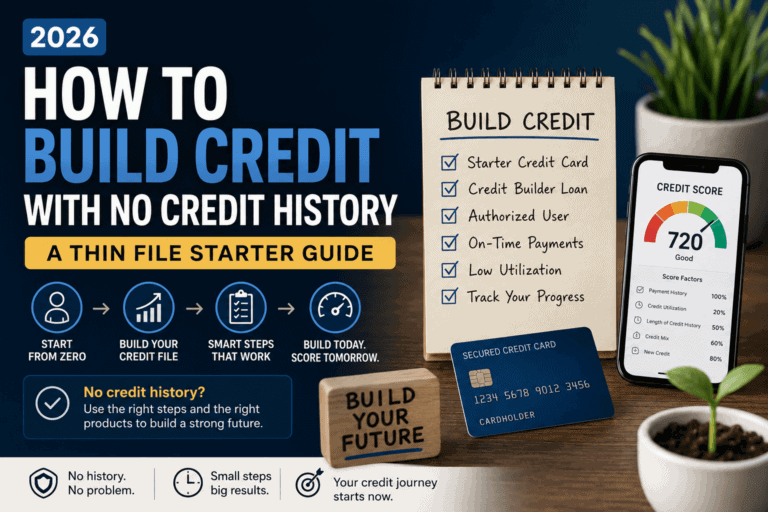
How to Build Credit as a Stay-at-Home Parent With No Income
Written by Credit Builder Guide Editorial Team
Credit Builder Guide is dedicated to helping Americans understand credit scores, improve financial habits, rebuild damaged credit, and make smarter borrowing decisions through simple, research-based educational content.
Fact-checked using trusted U.S. financial resources • Updated for 2026
Imagine a parent who has managed a household budget, paid every bill on time, and made every major financial decision alongside a spouse for a decade — and yet has no credit history in their own name. It’s a more common situation than many people realize, and it can create real problems if a marriage ends, a spouse becomes unable to work, or the stay-at-home parent simply wants financial independence.
The reason this happens is straightforward: many stay-at-home parents assume they can’t qualify for credit without personal income, so they never apply. In reality, U.S. law specifically allows for this situation to be addressed. This guide explains how.
Why Stay-at-Home Parents Face a Unique Credit Gap
Unlike someone who has never worked, a stay-at-home parent often has years of financial responsibility — managing bills, budgeting, and making joint decisions — without any of it appearing on a credit report in their name. If all financial accounts are held jointly or solely by a working spouse, the stay-at-home parent’s own credit file may remain thin or completely empty, even after many years of marriage.
This becomes a real problem in situations like divorce, the sudden death of a spouse, or a spouse’s job loss, where the stay-at-home parent may suddenly need to qualify for credit entirely on their own, with no history to show for it.
The Law That Makes This Possible: Household Income Rules
A rule from the Consumer Financial Protection Bureau allows credit card applicants who are 21 or older to include income they reasonably have access to, not just income they personally earn. This means a stay-at-home parent can generally include a spouse’s income, or other household income they have reasonable access to, when applying for a credit card in their own name.
This rule exists specifically to prevent financial institutions from denying credit access to spouses who don’t have independent income, recognizing that many households manage money jointly even when only one partner is formally employed.
Step 1: Understand What Counts as «Income» on an Application
Before applying, it helps to understand what a card issuer is actually asking for. Most applications ask about income the applicant can reasonably access — this can include a spouse’s salary, household income the applicant has access to for bill payment, or other regularly available funds. It generally does not require the applicant to be the one earning the money directly.
Because policies and application language vary by issuer, it’s worth reading the application carefully or contacting the issuer directly if there’s uncertainty about how to report household income.
Step 2: Apply for a Card Using Household Income
With that understanding, a stay-at-home parent can apply for a credit card in their own name, using accessible household income on the application rather than leaving the income field blank or reporting zero. This is different from being an authorized user — the resulting account and credit history belong entirely to the applicant.
Approval still depends on the issuer’s broader criteria, including credit history (or lack of it) and the specific card’s requirements, so starting with a card designed for limited or no credit history may be a more realistic first step than applying for a premium rewards card.
Step 3: Consider a Joint Account as a Backup Option
If a stay-at-home parent isn’t approved independently, opening a joint credit card account with a spouse is another option. On a joint account, both parties are equally responsible for the debt, and the payment history generally reports to both individuals’ credit files.
This differs from being an authorized user, where only one person is legally responsible for the debt even though it may appear on both credit reports. A joint account creates shared legal responsibility, which is worth understanding fully before opening one.
Step 4: Build Independent Credit History Over Time
Once an account is open — whether independently approved using household income or set up jointly — the same fundamentals apply as with any credit-building situation: pay on time, keep balances low relative to the limit, and avoid unnecessary new applications. Over time, this builds a credit file that belongs to the stay-at-home parent individually, separate from a spouse’s financial situation.
Why This Matters Even in a Stable Marriage
Even in a financially stable, long-term marriage, having an individual credit history matters. It provides a financial safety net in case of divorce, widowhood, or a spouse’s incapacity, and it can also simply make life easier — qualifying independently for a car loan, a personal credit card, or another financial product without needing a spouse as a co-applicant.
Common Mistakes to Avoid
- Leaving the income field blank or entering zero on an application, when household income the applicant has reasonable access to could have been reported instead.
- Assuming an authorized user account is enough. It can help build a credit file, but it doesn’t create independent legal responsibility or necessarily reflect the applicant’s own account history in the same way an individually held or joint account does.
- Applying for a premium card first. Starting with a card designed for limited credit history is often more realistic for a first independent account.
- Not discussing the household finances involved with a spouse before applying. Since household income is being used on the application, it’s worth having a clear conversation about the household’s overall financial picture.
FAQ: Building Credit With No Personal Income
Is it legal to use my spouse’s income on a credit card application if I don’t work?
Yes. Consumer protection rules specifically allow applicants 21 or older to include income they reasonably have access to, which can include a spouse’s income, even if the applicant doesn’t personally earn it.
Does this rule apply to unmarried partners too?
The rule generally applies to any income the applicant can reasonably access, not exclusively spousal income, though specifics can vary by issuer and situation. It’s worth confirming directly with the card issuer.
What’s the difference between a joint account and an authorized user account?
On a joint account, both parties are legally responsible for the debt. As an authorized user, only the primary cardholder is legally responsible, even though the account may appear on the authorized user’s credit report as well.
Can I be denied a credit card just because I don’t have a job?
An issuer can still deny an application based on their broader approval criteria, including credit history, but they cannot require personal employment income if the applicant is reporting accessible household income under current consumer protection rules.
Should I still build my own credit if my spouse already has excellent credit?
Yes. An individual credit file provides financial independence and protection in situations like divorce, widowhood, or a spouse’s inability to manage finances, regardless of how strong a spouse’s credit currently is.
Conclusion
Not having personal income doesn’t have to mean not having credit. U.S. consumer protection rules specifically allow stay-at-home parents and others without independent income to apply for credit using household income they can reasonably access. Building an individual credit history — whether through an independently approved account or a joint account — provides financial security that extends well beyond any single relationship or life stage.
Your Action Plan for TODAY
- Pull your credit report to see whether you currently have any credit history in your own name.
- Research credit card options designed for limited or no credit history.
- When applying, report household income you can reasonably access rather than leaving the field blank.
- If you’re not approved independently, discuss opening a joint account with your spouse.
- Once an account is open, set up autopay and monitor your usage to build a positive history.
Related Guides
- How to Build Credit from Zero: A Complete Guide for No Credit History in 2026
- Authorized User: Can It Really Boost Your Credit Score?
- Secured Credit Card vs Prepaid Card: Which Actually Builds Credit in 2026?
Disclaimer
This article is for educational and informational purposes only and does not constitute personalized financial or legal advice. Credit card issuer policies, approval criteria, and applicable consumer protection rules may change over time. Individual results depend on personal financial circumstances. Readers should verify current requirements directly with card issuers or consult a qualified financial professional before applying for credit.
Sources & References
- Consumer Financial Protection Bureau (CFPB) — consumerfinance.gov
- Federal Trade Commission (FTC) — ftc.gov
- Experian, Equifax, and TransUnion consumer education resources