Meta Description: Learn how to build credit from zero in 2026 if you have no credit history or a thin credit file, including which starter products actually work and in what order.
How to Build Credit From Zero: A Complete Guide for No Credit History in 2026
Written by Credit Builder Guide Editorial Team
Credit Builder Guide is dedicated to helping Americans understand credit scores, improve financial habits, rebuild damaged credit, and make smarter borrowing decisions through simple, research-based educational content.
Fact-checked using trusted U.S. financial resources • Updated for 2026
What «No Credit History» Actually Means
Imagine you’re 20 years old, or you recently moved to the United States, or you’ve simply never used credit, and you go to rent an apartment or apply for a basic credit card. Instead of a rejection based on a low score, you get a different, more confusing message: «insufficient credit history.»
This happens because you don’t actually have a bad score — you have no score at all. The three major credit bureaus (Equifax, Experian, and TransUnion) can only generate a credit score once they have enough reported account activity to calculate one. If nothing has ever been reported in your name, there’s simply no data to score.
This is commonly called having a thin file (a small amount of credit history) or no file (no credit history at all). It’s a completely different starting point from having a damaged credit history, and it requires a different strategy.
This guide focuses specifically on how to go from zero accounts to an established, scorable credit history. It does not cover improving an already-existing low score — for that, see our 6-Month Roadmap From 500 to 700.
Why a Thin File Is Different From Bad Credit
It’s worth separating these two situations clearly, since the fixes are not the same:
| Situation | What’s happening | General approach |
|---|---|---|
| No credit history (thin/no file) | No accounts have ever been reported, so there isn’t enough data for a score | Open new accounts designed for beginners and let them season over time |
| Bad or damaged credit | Accounts exist, but include missed payments, high balances, or collections | Address the specific negative items and rebuild responsible history |
If you have no file, there’s nothing to «fix» — there’s only a foundation to build. That’s actually a more straightforward starting point than repairing damaged credit, even though it doesn’t feel that way when every application gets denied.
What You Need Before You Start
Before opening any account, make sure you have:
- A Social Security number or Individual Taxpayer Identification Number (ITIN), depending on the product and issuer.
- Proof of income or funds, since some starter products require you to show you can make payments.
- A U.S. mailing address and, in most cases, a U.S. bank account, which most starter credit products require.
- Realistic expectations, since building a file from zero takes months, not days, regardless of which products you choose.
Step 1: Open a Starter Credit-Building Product
You need at least one account that reports to the credit bureaus. The most common starting points are:
Secured credit cards. You provide a cash deposit (often equal to your credit limit), and the card functions like a normal credit card that reports monthly to all three bureaus. This is one of the most widely used starting points for someone with no file. We cover how secured cards compare to prepaid cards in detail in our Secured Credit Card vs. Prepaid Card guide — note that prepaid cards, unlike secured cards, generally do not build credit at all, which is an important distinction if you’re choosing between the two.
Credit builder loans. Instead of receiving money upfront, your payments go into a locked savings account that you receive once the loan is paid off, while your on-time payments are reported to the bureaus the entire time. These are offered by many credit unions, community banks, and online lenders. We explain how these loans work in full in our Credit Builder Loan guide.
Becoming an authorized user. If a trusted family member has a credit card in good standing, being added as an authorized user can let their account history appear on your credit report. This doesn’t require your own credit application at all, but it depends entirely on the primary cardholder’s habits. See our Authorized User guide for the benefits and risks of this approach.
For most people starting from zero, a secured credit card or a credit builder loan is the more independent option, since it doesn’t rely on someone else’s account.
Step 2: Add a Second Type of Account (If Possible)
Once your first account is open and reporting, consider adding a second type of account after a few months, rather than immediately. Having a mix of account types (for example, one revolving account like a credit card and one installment account like a credit builder loan) can support a stronger file over time than having only one type.
This doesn’t mean opening multiple accounts at once. Applying for several new accounts in a short period can generate multiple hard inquiries and may look risky to lenders evaluating a file with no track record yet. Space out new applications, generally waiting until your first account has several months of on-time payment history.
Step 3: Use Alternative Data to Get a Head Start
Traditional credit accounts aren’t the only way to start showing payment history. Several tools can incorporate non-traditional payment data into your file:
- Rent reporting services. Some services report your on-time rent payments to one or more bureaus, which can help establish history even before you open a credit card or loan.
- Utility and phone bill reporting programs. Certain credit-monitoring tools allow on-time utility or phone payments to be factored into alternative credit scoring models.
- Bureau-specific boost programs. Some bureaus offer programs that let you voluntarily add qualifying bank account or bill-payment data to your file.
These tools generally work best as a supplement to, not a replacement for, a traditional credit account, since not all lenders consider alternative data when reviewing an application.
Step 4: Build the Habits That Actually Create a Score
Opening an account is only the starting point. The habits you build from there are what actually generate a usable score:
- Pay on time, every time. Payment history is the single largest factor in most scoring models, and it matters just as much for a brand-new file as it does for an established one.
- Keep balances low relative to your limit. Even with a small starter credit limit, try to use a modest portion of it and pay it off in full when possible.
- Let the account season. Scores typically require a minimum number of months of reported activity before they can be calculated at all, so avoid closing your first account too early.
- Check your credit report periodically once you have at least one open account, to confirm it’s being reported accurately. You can access your reports through our Free Credit Report guide.
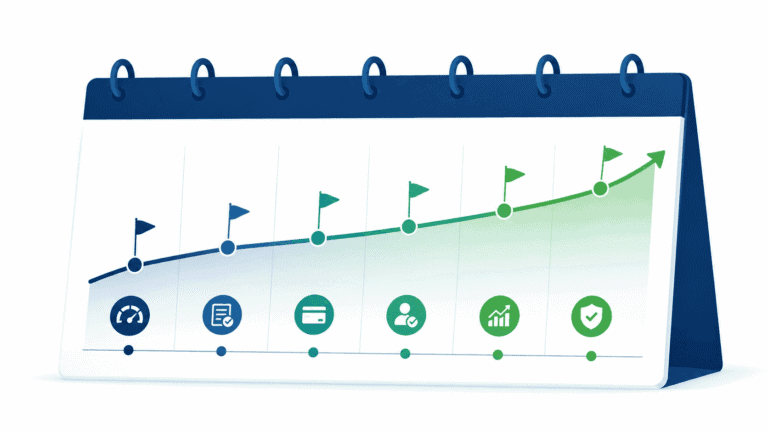
Realistic Timeline: When Will You Have a Score?
Most scoring models require an account to be open and reporting for a minimum period, along with a minimum amount of activity, before a score can be generated. In general terms:
- Early months: Your account exists but may not yet generate a score, since scoring models typically need several months of history.
- Mid-range months: A score often becomes available, though it may sit in the fair or limited range simply because the file is still young.
- Ongoing: As you add on-time payments, keep utilization low, and potentially add a second account type, your file matures and your score typically has room to strengthen.
Exact timelines vary by scoring model and by how you use your accounts, so treat this as a general pattern rather than a guarantee. For a broader look at rebuilding timelines generally, see our How Long Does It Take to Rebuild Credit guide.
Common Mistakes People With No Credit History Make
- Applying for several cards or loans at once, hoping one will approve. This creates multiple hard inquiries on a file that has no track record to offset them.
- Assuming a prepaid debit card builds credit. Prepaid cards generally do not report to credit bureaus at all, since they aren’t a form of borrowing.
- Closing the first account too soon after getting approved for a better product, which can shorten your average account age later.
- Maxing out a small starter credit limit, which can create high utilization even if the dollar amount is small.
- Ignoring the account entirely after opening it, and missing a payment simply due to lack of attention rather than inability to pay.
Who This Applies To
This guide is generally most relevant for:
- Young adults applying for their first credit product.
- Immigrants or newcomers to the U.S. financial system who may have credit history in another country that doesn’t transfer to U.S. bureaus.
- Anyone who has simply never used a credit account, by choice or circumstance.
- People re-entering the credit system after a long period without any open accounts.
FAQ: Building Credit From No History
How many accounts do I need to get a credit score?
Scoring models generally require at least one account with several months of reporting history, though having more than one account, and a mix of types, can support a stronger file over time. There’s no fixed universal minimum number, since it depends on the specific scoring model used.
Can I get a regular, unsecured credit card with no credit history?
It’s possible but generally harder, since most unsecured card issuers use credit history to evaluate risk. Secured cards, credit builder loans, and authorized user status are typically more accessible starting points.
Does checking my own credit report hurt my score if I have no file?
No. Checking your own credit report is a soft inquiry and does not affect your credit score, regardless of whether you already have a file or not.
Will my international credit history transfer to U.S. bureaus?
Generally, no. U.S. credit bureaus typically do not import credit history from other countries, which means newcomers to the U.S. often start with no file even if they have an established credit history elsewhere.
Is it better to start with a secured card or a credit builder loan?
Both can work well, and they build different things: a secured card establishes revolving credit history, while a credit builder loan establishes installment credit history and forced savings. Some people use one first and add the other a few months later.
How long should I wait between opening my first and second account?
There’s no fixed rule, but many people wait until their first account has several months of on-time payment history before applying for a second, to avoid stacking multiple hard inquiries on a file with no track record yet.
Conclusion
Building credit from zero isn’t about repairing anything — it’s about establishing a track record where none currently exists. The path generally involves opening at least one starter credit product, using it responsibly, letting it season over several months, and potentially adding a second account type or alternative data source along the way.
There’s no way to guarantee a specific score or timeline, since scoring depends on your individual accounts, payment history, and the scoring model used. But the fundamentals — pay on time, keep balances low, and be patient — apply to every stage of building a credit history, starting with the very first one.
Your Action Plan for Today
- Decide on your first credit-building product: a secured credit card, a credit builder loan, or authorized user status, based on what you qualify for right now.
- Gather the documents you’ll need, including proof of income and identification, before applying.
- Check whether a rent or utility reporting service is available to you, so you can start building alternative payment history immediately.
- Set up autopay for at least the minimum payment on any new account, so a missed payment never derails your first months of history.
- Mark your calendar for 6 months out to check whether a credit score has been generated yet, and review your credit report at that point.
Related Guides
- Secured Credit Card vs. Prepaid Card: Which Actually Builds Credit in 2026
- Credit Builder Loan: What It Is and How It Works in 2026
- Authorized User: Can It Really Boost Your Credit Score?
Disclaimer
This article is for educational and informational purposes only and does not constitute personalized financial or credit advice. Credit scoring timelines, minimum reporting requirements, and program availability vary by scoring model, lender, and individual circumstances, and may change over time. No specific credit score, approval outcome, or timeline is guaranteed. Readers should verify current program details directly with credit bureaus, lenders, or card issuers, and consider speaking with a qualified financial professional for guidance specific to their situation.
Sources & References
- Consumer Financial Protection Bureau (CFPB) — consumerfinance.gov
- Federal Trade Commission (FTC) — consumer.ftc.gov
- FICO — myfico.com
- Experian — experian.com
- Equifax — equifax.com
- TransUnion — transunion.com


8 comentarios